
The Lowest EMS Quote Usually Ends Up Costing You More. Here Is Why OEMs Keep Learning This the Hard Way.
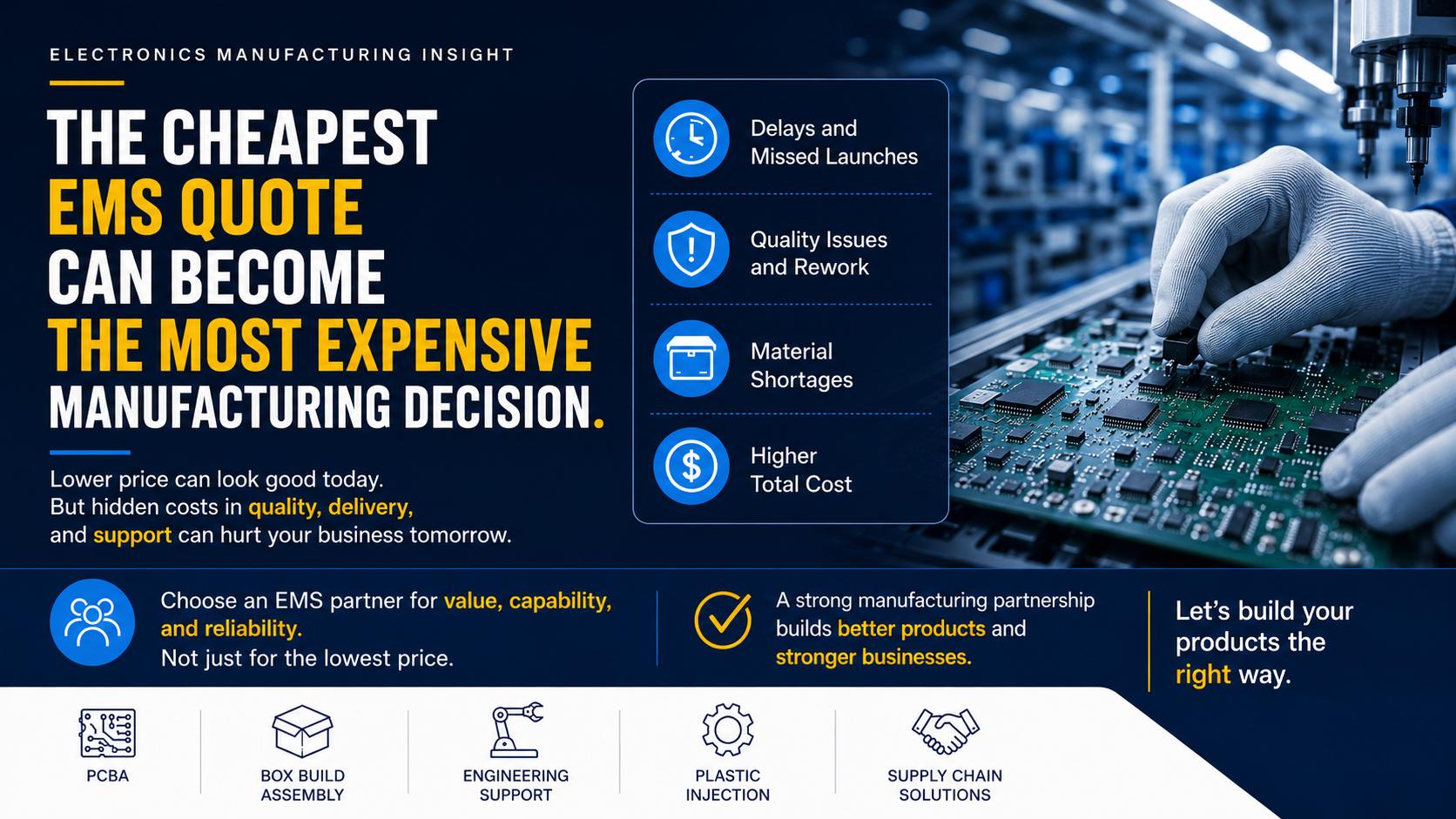
Choosing an EMS partner based only on the lowest unit price can look good on paper. But for OEM companies, the real cost often appears later through defects, rework, delays, field failures, and painful requalification.
You send out an RFQ. Ten suppliers come back. One of them is 30% cheaper than everyone else. Most people go with it. And six months later, they understand exactly why that number was so low.
What I See Happen Over and Over Again
An OEM team needs a manufacturing partner for PCBA, box build, or a full assembly program. They send out the RFQ, compare quotes, and choose the lowest one. It makes sense on paper. Procurement is measured on savings. No one gets rewarded for paying more.
But unit price is only one number in a much bigger equation. It is also usually the least honest one. In electronics manufacturing, the cheapest quote is often cheap for a reason.
It may skip incoming inspection. It may not include real engineering support. It may cut corners on component traceability. You usually do not find out until something goes wrong on the production line, or worse, in the field.
The uncomfortable truth is this. Some EMS providers price low because their model depends on volume, not quality. If you are a small or mid sized OEM, you may not be their priority customer. They will not tell you this when they send the quote. You find out when your production run is delayed or your field return rate starts climbing.
Why This Hits OEM Companies Harder Than Most People Realize
For OEMs, manufacturing quality does not stay on the factory floor. It travels with your product all the way to your end customer.
A PCBA that passes a weak final inspection gets boxed, shipped, installed, and returned. That is not just a warranty cost. That is your reputation.
And here is what makes it worse. Switching EMS partners mid production is not like changing a supplier for bolts. It means requalification, new documentation, possible retooling, and a timeline hit you probably cannot afford.
The affordable partner that looked fine on the quote can lock you into a costly cycle that burns through your margin for months.
What the Quote Does Not Show You
- Rework and scrap. Weak soldering, wrong component placement, and no proper AOI or X ray testing can wipe out everything you saved on unit price.
- Missed delivery windows. A supplier that overcommits on capacity can fail your schedule. Late shipments affect your customers and revenue directly.
- Counterfeit components. Without proper sourcing controls and incoming inspection, gray market parts can enter your BOM. The liability from field failures can be serious.
- Requalification cost. Starting over with a new EMS partner after a failure can mean NPI restart, lost time, and a production gap you cannot easily recover.
What This Looks Like in Practice
A mid sized industrial OEM switched to a lower cost PCBA partner in Southeast Asia to cut unit cost by 18%. Within two production runs, field return rates climbed from 1.2% to over 6%. The root cause was inconsistent soldering and undocumented component substitutions.
By the time they recovered, the total cost of the switch was more than four times what they saved on price. That is not a rare story. I have seen versions of it more than once.
Before You Award the Contract, Ask These Six Questions
1. Can they show defect and return data?
Ask for DPPM or first pass yield figures. A serious EMS partner will have this. If they cannot produce it, that tells you something.
2. Where do their components come from?
Authorized distributors only, or do they buy on the open market? This question alone separates serious partners from the rest.
3. Do they offer real engineering support?
Can they help with DFM reviews, BOM optimization, and testability? Or do they just assemble what you hand them and leave you to figure out the problems?
4. Are you actually a priority at that factory?
A small OEM program at a large, volume focused factory often gets deprioritized when things get busy. Know where you stand before you sign.
5. How do they handle problems?
Do they proactively flag issues or wait for you to find them? Communication speed and transparency during production problems matter more than most people think.
6. Can they give references at your volume level?
A supplier doing well at 100,000 units a month may not be the right fit for a 500 to 5,000 unit OEM program. Volume fit is real.
What a Good EMS Partner Actually Does
A good EMS partner asks questions before they quote. They want to understand your end use environment, field return tolerance, timeline, and what your product needs to do reliably in the real world.
They flag DFM issues before they become field problems. They tell you when a component substitution is risky. They communicate clearly when something on the line needs your attention instead of hoping you will not notice.
There are EMS providers and contract manufacturing partners in the Philippines and across Southeast Asia doing exactly this kind of work for OEM companies.
The Philippines, in particular, has a strong base of technically trained engineers, English fluent teams, and quality focused manufacturers who take mid tier OEM programs seriously rather than treating them as low priority filler.
How DML Approaches EMS Partnerships
At DML, this is how we approach every new engagement. Not with the lowest possible number, but with a clear picture of what it takes to protect your product, your schedule, and your customer relationships.
That conversation is what builds a reliable manufacturing partnership.
The Takeaway
A 15% to 20% lower unit price from an unqualified EMS partner can easily produce a 40% to 60% higher total cost once you account for defects, delays, rework, and requalification.
Evaluate your EMS partners on total cost, quality capability, and supply chain reliability. The quote is just the beginning of the conversation.
A Question for OEM Leaders
If you have worked in OEM sourcing, engineering, or supply chain, what changed the way your team evaluated EMS partners?
Was it a bad experience that forced a rethink, or did someone in the room make the case before things went wrong?
Evaluating EMS Partners for Your Next Program?
If you are evaluating EMS partners in the Philippines, Southeast Asia, or anywhere else, DML can help you have a practical conversation about quality, cost, supply chain risk, and manufacturing fit.
Talk to DML