
Why Logistics Planning Matters in OEM Supply Chains
Better warehousing, packaging, import export coordination, and delivery planning can protect customer commitments, reduce avoidable delays, and keep OEM supply chains moving with greater control.
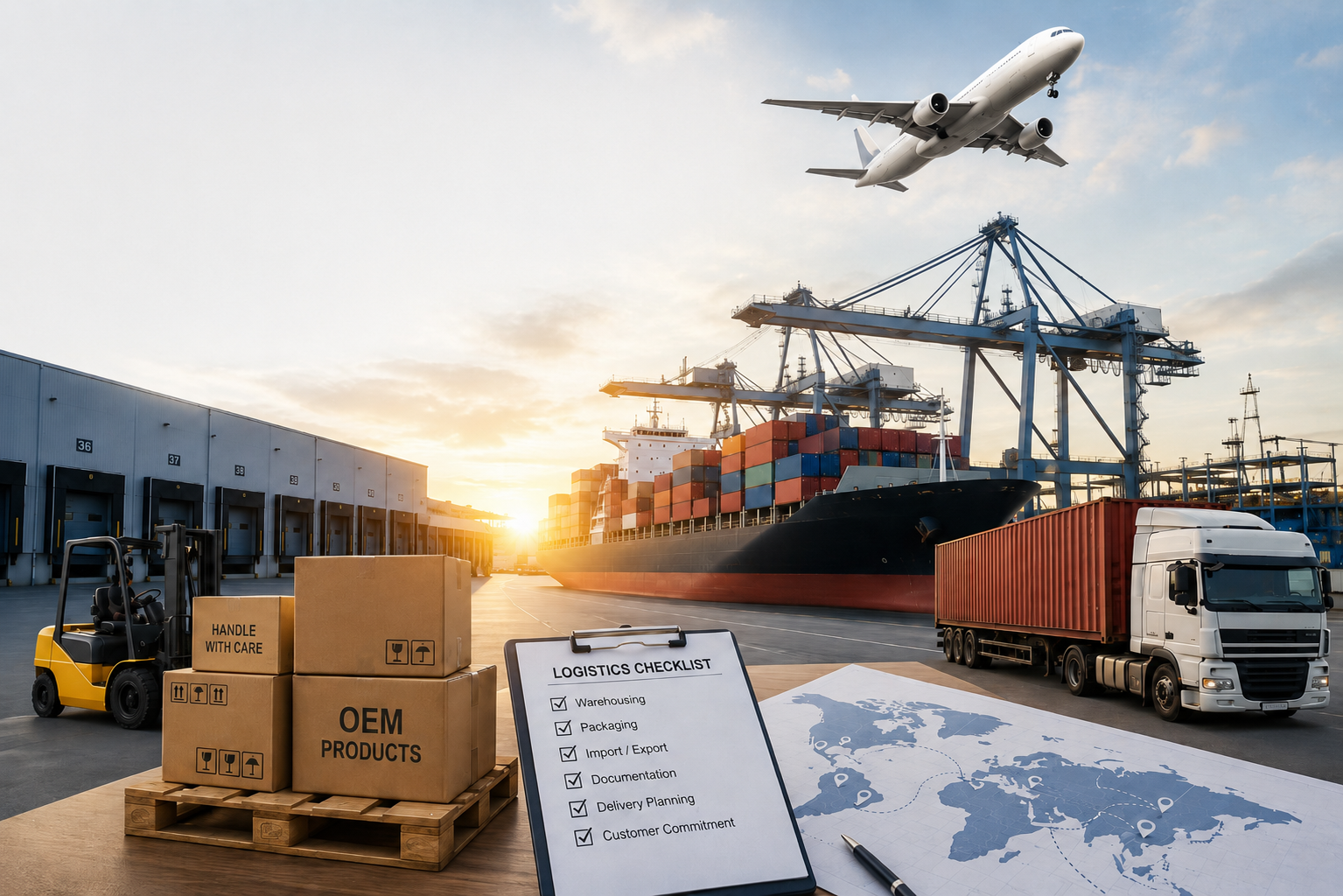
A product is not truly finished when it leaves the production line. For OEM customers, the job is not complete until the right product reaches the right place, in the right condition, at the right time.
Why Logistics Planning Is More Than Shipping
Many OEM teams focus heavily on manufacturing cost, supplier capability, and production lead time. Those are important, but they are only part of the supply chain picture.
A product can be well built and still fail the customer experience because of poor warehousing, weak packaging, missing documents, delayed customs handling, or unclear delivery planning.
Logistics planning is not just about moving boxes. It is about protecting customer commitments. It connects manufacturing, inventory, documentation, transportation, import export requirements, and delivery execution into one workable flow.
For OEM companies, this matters because every shipment carries more than products. It carries revenue, schedule commitments, customer trust, and brand reputation.
1. Warehousing Protects Availability and Control
Warehousing is not only storage. For OEM supply chains, it supports inventory control, shipment staging, production readiness, and delivery timing.
Without proper warehousing coordination, products can be misplaced, delayed, damaged, or shipped without the right preparation.
Good warehousing support helps with
- Inventory visibility and control
- Shipment staging before delivery
- Separation of finished goods and raw materials
- Proper handling of sensitive components and assemblies
- Faster response to customer delivery schedules
- Reduced confusion during urgent shipments
For OEMs with changing forecasts or customer delivery windows, warehousing gives the supply chain more flexibility.
2. Packaging Protects Product Quality
Packaging is often treated as a small detail until something goes wrong.
Poor packaging can lead to damaged products, missing labels, rejected deliveries, customer complaints, and added rework. For electronics, mechanical parts, assemblies, and finished goods, packaging should match the product risk.
Packaging should consider
- Product fragility
- Moisture and humidity risk
- ESD protection for electronic parts
- Export carton strength
- Labeling and traceability requirements
- Customer receiving requirements
- Shipping method and travel distance
The cheapest packaging is not always the lowest cost option. If packaging failure creates damage, returns, or customer disruption, the real cost becomes much higher.
3. Import Export Coordination Reduces Delays
International supply chains depend on proper documentation and coordination. A shipment can be ready at the factory but still be delayed because of incomplete paperwork, incorrect product details, unclear consignee information, or customs related issues.
OEM teams need logistics partners who understand that documents are not administrative extras. They are part of the delivery process.
Import export coordination should cover
- Commercial invoice accuracy
- Packing list details
- HS code review support
- Country of origin information
- Brokerage coordination
- Shipping method alignment
- Customer specific documentation requirements
When import export details are handled late, shipments can sit at ports, airports, or customs channels while the customer waits.
4. Delivery Planning Protects Customer Commitments
Delivery planning is where manufacturing promises meet customer expectations.
A late delivery can affect installation schedules, production lines, field service, inventory planning, and customer revenue. For OEMs, this can quickly become a commercial problem, not just a logistics problem.
Strong delivery planning looks ahead. It asks what must move, where it must go, when it must arrive, what documents are needed, and what risks could interrupt the timeline.
Good delivery planning includes
- Clear shipment schedule
- Realistic transit time
- Coordination with warehouse and receiving teams
- Packaging readiness
- Document readiness
- Backup plan for urgent shipments
- Communication before delays become customer problems
The best logistics planning does not wait for failure. It identifies possible bottlenecks early and keeps the customer informed.
5. Logistics Mistakes Can Erase Manufacturing Savings
A manufacturing program may save cost at the production stage, but lose that savings through poor logistics execution.
Extra storage charges, missed deliveries, emergency freight, damaged goods, customs delays, and customer penalties can quickly erase margin.
The Hidden Cost of Weak Logistics
Weak logistics planning often shows up as emergency air freight, delivery penalties, rejected shipments, damaged products, warehouse confusion, or customer complaints.
By the time these costs appear, the issue is usually no longer just a logistics issue. It has become a customer relationship issue.
6. Communication Is the Heart of Logistics Control
Logistics requires coordination between suppliers, warehouses, freight providers, brokers, customer receiving teams, and internal stakeholders.
When communication is weak, even simple shipments become difficult.
OEM teams should ask
- Who owns the shipment update?
- Who confirms packaging and labeling readiness?
- Who checks the shipping documents?
- Who communicates customs or delivery delays?
- Who informs the customer before problems escalate?
Clear ownership reduces confusion. It also helps OEM teams respond faster when something changes.
7. What OEMs Should Check Before Choosing a Logistics Partner
OEMs should evaluate logistics support with the same seriousness used in manufacturing partner evaluation.
Check these areas
- Warehouse handling capability
- Packaging and labeling support
- Experience with industrial or electronic products
- Import export coordination capability
- Documentation discipline
- Communication speed
- Delivery planning process
- Ability to support urgent or changing requirements
A good logistics partner should help you reduce uncertainty. They should not add more confusion to the supply chain.
How DML Helps OEM Customers
DML helps OEM customers coordinate warehousing, logistics, packaging, labeling, import export support, shipment planning, and distribution requirements.
We understand that supply chain execution does not end at manufacturing. The product still needs to be stored properly, prepared correctly, documented accurately, and delivered reliably.
Our role is to help customers move from requirement to delivery with practical coordination and clear support.
The Takeaway
Logistics planning matters because it protects customer commitments. Better warehousing, packaging, import export coordination, and delivery planning help OEM companies reduce delays, avoid unnecessary cost, and improve customer confidence.
A product is not truly delivered when it is finished. It is delivered when the customer receives it correctly, on time, and ready for use.
Need Help With Logistics and Distribution Planning?
If you need support with warehousing, packaging, import export coordination, shipment planning, or delivery execution, DML can help you identify a practical next step.
Talk to DML