
How OEMs Should Evaluate Manufacturing Partners
Choosing a manufacturing partner is not just a purchasing decision. For OEM companies, it is a long term business decision that affects quality, cost, delivery, customer trust, and product reputation.
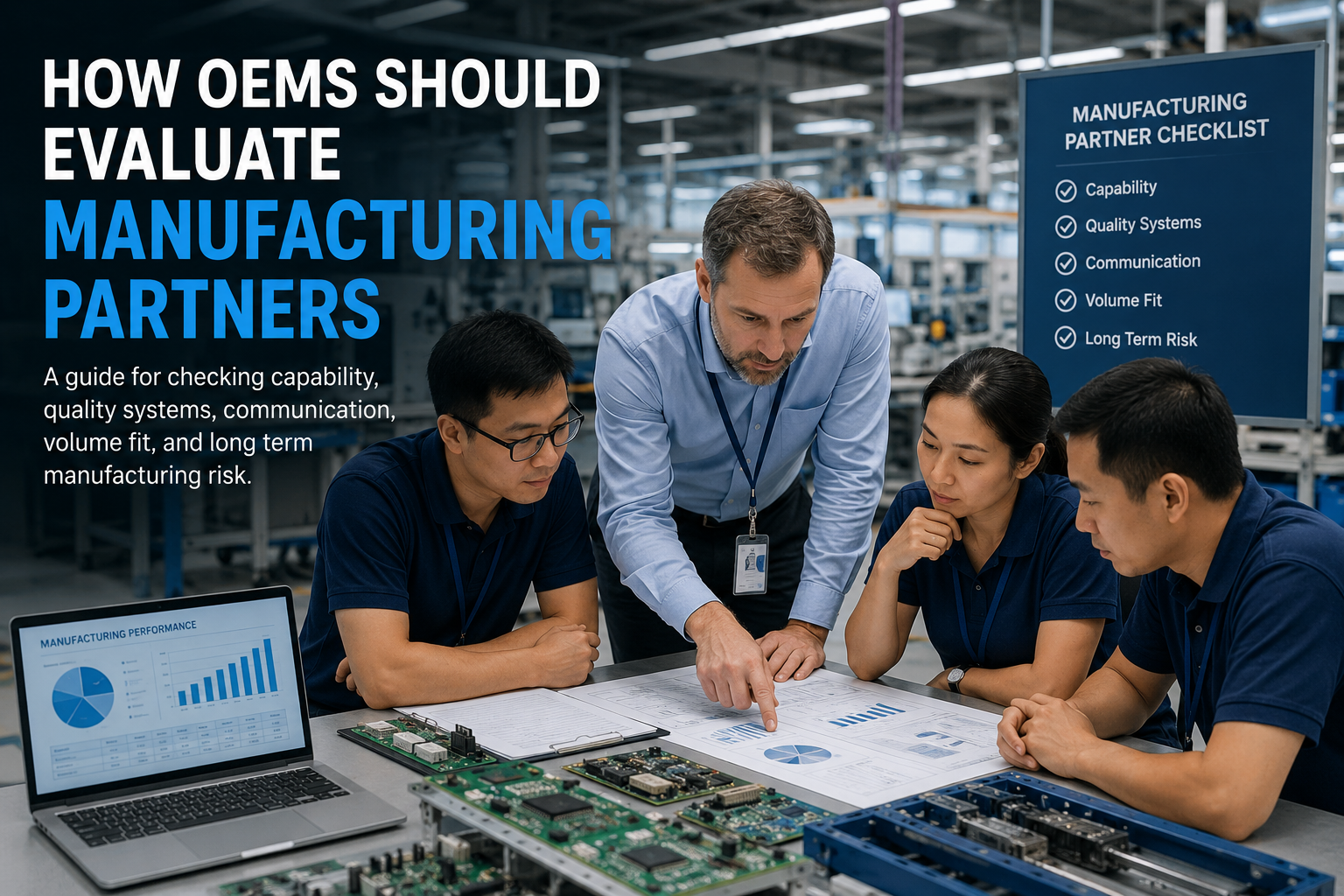
The wrong manufacturing partner does not only create production problems. It creates customer problems, engineering problems, cash flow problems, and reputation problems.
Why Manufacturing Partner Evaluation Matters
Many OEM teams evaluate manufacturing partners by looking first at price, location, and available capacity. Those things matter, but they are not enough.
A supplier can offer a good quote and still be a poor fit. They may not understand your product requirements. They may not have the right quality system. They may be too large to care about your volume, or too small to support your growth.
For OEM companies, a manufacturing partner becomes part of the product experience. Their process, discipline, communication, and supply chain decisions eventually reach your end customer.
That is why manufacturing partner evaluation should be structured, practical, and honest. You are not only asking, “Can they build it?” You are asking, “Can they build it correctly, repeatedly, reliably, and at the right level of risk?”
1. Check Their Real Capability, Not Just Their Brochure
Most manufacturers can present a good capability list. The question is whether that capability matches your product, volume, complexity, and industry requirements.
If you need PCBA, box build, plastic parts, metal fabrication, wire harness, or full product assembly, do not accept broad claims. Ask for proof that they have done similar work before.
Questions to ask
- Have they built products similar to yours?
- Do they understand your application and end use environment?
- Can they support prototype, pilot run, and production stages?
- Do they have the right equipment, process controls, and technical people?
- Can they scale if your demand increases?
A good manufacturing partner will not simply say yes to everything. They will ask questions. They will clarify assumptions. They will tell you where the risks are.
2. Review Their Quality System
Quality is not only about final inspection. A weak manufacturer tries to catch defects at the end. A strong manufacturer builds quality into the process.
This matters especially for electronics manufacturing, PCBA, box build, industrial products, and assemblies where field failure can be costly.
Look for quality discipline in these areas
- Incoming inspection process
- Component traceability
- Work instructions and process documentation
- In process inspection
- Final inspection and testing
- Defect tracking and corrective action
- Return analysis and failure feedback
Ask for data. First pass yield, defect rates, DPPM, corrective action reports, and audit results can reveal whether the quality system is real or only written on paper.
3. Evaluate Communication Speed and Transparency
Manufacturing problems are not always avoidable. What matters is how the partner communicates when problems happen.
Some suppliers wait until the issue becomes serious before they tell you. Others communicate early, show the facts, explain options, and help you make a decision before the problem grows.
A strong partner communicates clearly about
- Material shortages
- Engineering questions
- Yield issues
- Production delays
- Alternative components
- Schedule risks
- Cost changes
During evaluation, pay attention to how they respond before the contract is signed. Slow replies, vague answers, and unclear ownership during quoting usually become worse during production.
4. Check Volume Fit
Volume fit is one of the most overlooked issues in manufacturing partner evaluation.
A large factory may be excellent at high volume production but may treat your small or mid sized program as low priority. A smaller factory may give more attention, but may struggle if your demand grows quickly.
The right partner is not always the biggest one. The right partner is the one whose business model fits your volume, complexity, and support needs.
Ask these questions
- What is their ideal customer volume?
- Will your program be important to them?
- Can they support engineering changes and smaller production runs?
- Can they scale when your demand grows?
- Do they have flexibility for changing forecasts?
If your program does not fit their operating model, you may face slow response, schedule movement, weak attention, and poor support when capacity gets tight.
5. Understand Their Supply Chain Controls
A manufacturing partner is only as strong as the supply chain behind them.
For OEM programs, component sourcing, material availability, approved vendor lists, traceability, and substitution control are critical. A cheap build can become expensive when the wrong component enters your product.
Review these supply chain areas
- Authorized distributor usage
- Approved vendor list control
- Component traceability
- Substitution approval process
- Material shortage handling
- Alternative sourcing strategy
- Inventory and lead time management
Never allow undocumented substitutions. If a part changes, your team should know before it goes into production.
6. Check Engineering Support
OEMs often need more than build to print manufacturing. They need a partner who can review manufacturability, identify risk, and help prevent problems before production starts.
Good engineering support can reduce defects, improve cost, prevent delays, and support a smoother transition from prototype to production.
Look for support in
- Design for manufacturing review
- BOM review and optimization
- Testability review
- Process planning
- Prototype feedback
- Engineering change management
- Production readiness review
A partner who only follows instructions may be acceptable for simple builds. But for complex OEM programs, a partner who can think with you is much more valuable.
7. Evaluate Long Term Manufacturing Risk
A manufacturing decision should not only solve today’s quote. It should protect the product over time.
Long term risk includes supplier stability, financial health, capacity availability, material control, workforce capability, location risk, and the supplier’s willingness to support your program as it changes.
Consider these risk areas
- Can they support your product for several years?
- Do they have stable operations and leadership?
- Are they dependent on a few large customers?
- Can they handle demand changes?
- Do they have a plan for supply disruption?
- Can they support documentation and repeatability?
A low price today is not helpful if the partner creates instability six months later.
Simple Evaluation Scorecard for OEM Teams
Before awarding a manufacturing contract, score each partner from 1 to 5 in these areas: technical capability, quality system, communication, volume fit, supply chain control, engineering support, and long term risk.
The partner with the lowest price may still win. But they should only win after they prove that the total risk is acceptable.
What a Good Manufacturing Partner Looks Like
A good manufacturing partner asks questions before quoting. They want to understand the product, the application, the quality expectations, the target volume, the delivery needs, and the risk areas.
They are transparent when something does not fit. They show data. They communicate early. They help you protect the product instead of simply chasing the order.
They understand that OEM manufacturing is not only about making parts. It is about protecting customer trust.
How DML Helps OEM Customers
DML helps OEM customers evaluate manufacturing, sourcing, logistics, and supply chain options with a practical view of cost, capability, quality, and long term fit.
We help customers connect with capable manufacturing partners for electronics manufacturing, PCB assembly, box build, product development, component sourcing, logistics, and related production needs.
Our goal is not only to help customers find a supplier. Our goal is to help them find the right manufacturing path.
The Takeaway
OEMs should evaluate manufacturing partners based on more than price. Capability, quality systems, communication, volume fit, supply chain controls, engineering support, and long term manufacturing risk all matter.
The best partner is not always the cheapest. The best partner is the one that can protect your product, your customer, your schedule, and your long term business.
Evaluating a Manufacturing Partner?
If you are reviewing manufacturing partners for electronics, PCBA, box build, product assembly, sourcing, or supply chain support, DML can help you think through capability, quality, communication, and long term fit.
Talk to DML